
News
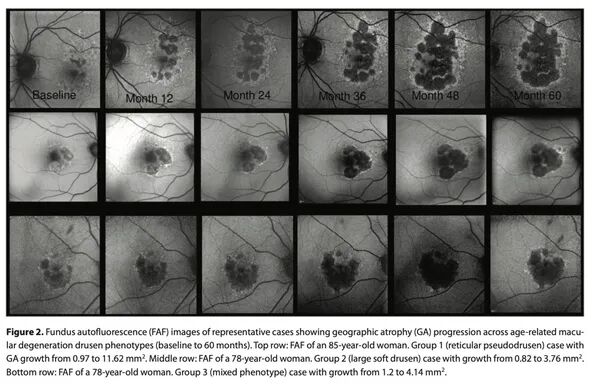
Geographic atrophy (GA), an advanced form of non-neovascular age-related macular degeneration (AMD), does not progress at the same rate in all patients.
Our question: can the type of drusen present before atrophy develops help predict its rate of enlargement?
We followed 59 eyes from 47 patients for up to five years using multimodal imaging. Eyes were grouped by phenotype: reticular pseudodrusen (RPD) alone, large soft drusen alone, or a mixed phenotype.
The area of atrophy was measured using fundus autofluorescence.
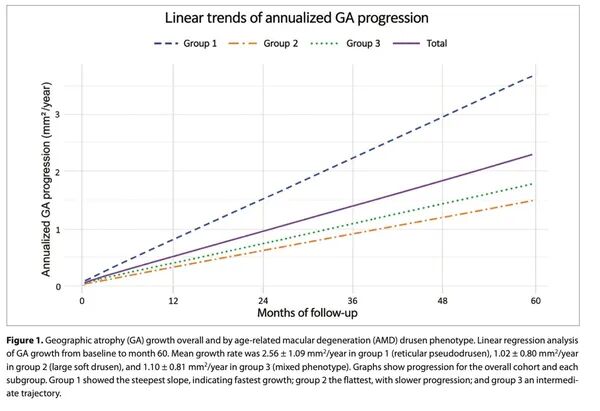
- In eyes with RPD alone, atrophy progressed approximately 2.5 times faster: 2.56 mm²/year, compared with 1.02 mm²/year in eyes with large soft drusen alone.
- A novel finding: when both types coexisted, progression resembled that seen with large soft drusen alone (1.10 mm²/year), rather than RPD alone.
- These differences persisted at every annual follow-up, from 12 to 60 months.
Drusen phenotype could help tailor follow-up, guide patient selection for new treatments, and inform the interpretation of clinical trial results in geographic atrophy.
Congratulations 👏 to the entire Créteil Retina Team on this collaborative study!
Read the publication: https://en.pr-eric-souied.com/service/document/document/0508a830-d123-11f1-a17a-737d790a3ccf


Dear Friends,
I had the honor of delivering the Lumbroso Lecture at FLORetina–ICOOR 2025 in Florence.
My presentation, entitled “Gene therapy for Neovascular AMD: are we moving toward a cure?”, provided an opportunity to review recent advances in gene therapy applied to neovascular AMD.
I discussed:
• the clinical data currently available,
• the limitations that must be considered when interpreting results,
• and the perspectives that may guide the next stages of development.
Receiving this distinction, bearing the name of Prof. Bruno Lumbroso, and speaking within such an inspiring setting was a significant moment.
I return from Florence with gratitude, renewed energy, and a strengthened conviction: the decade ahead will be decisive for our patients.
My thanks to the organizers, the scientific committee, the research teams, and all those who contribute to advancing this field at the crossroads of innovation, science, and patient care.