Professor Eric Souied is internationally recognized for his pioneering research on retinal and macular diseases.
His scientific work bridges clinical ophthalmology and genetic research, with a focus on understanding, preventing, and treating age-related macular degeneration (AMD).
Through collaborations with French and international institutions, Professor Souied contributes to advancing new diagnostic tools, identifying genetic risk factors, and developing innovative therapeutic strategies.
Research themes
Genetics of AMD
Genetics of AMD
Age-Related Macular Degeneration (AMD) is a progressive ocular disease that stands as one of the main causes of vision loss in the elderly. It is characterized by the deterioration of the macula, a region of the retina responsible for central vision. AMD can be classified into two main forms: dry AMD (or atrophic) and wet AMD (or exudative). Genetics plays a significant role in the development of AMD, and among the associated genes, ApoE has garnered particular interest through the research conducted by Dr. Eric Souied and his team in 1998.
Genetics of AMD
AMD is a multifactorial disease, meaning it results from the complex interaction of genetic and environmental factors. Several epidemiological studies have shown that heredity plays a significant role in predisposition to AMD. Research conducted over many years has identified various genetic variants associated with an increased risk of developing the disease.
ApoE and AMD
Apolipoprotein E (ApoE) is a protein involved in lipid transport in the body, particularly in lipoprotein metabolism. ApoE is encoded by the APOE gene, and there are three main isoforms of ApoE: ApoE2, ApoE3, and ApoE4, differing by a few amino acids. ApoE4 variants are known to be associated with an increased risk of neurodegenerative diseases, including Alzheimer's disease. Dr. Eric Souied's research and his team have shed light on the role of ApoE in AMD. Their studies have shown that the presence of the ApoE4 variant is associated with an increased risk of developing the dry form of AMD. This ApoE variant appears to enhance susceptibility to AMD by altering retinal lipid metabolism and contributing to inflammation and deposits accumulation in the macula.
Other Involved Genes
Besides ApoE, other genes have been identified as associated with AMD. For example, variants in the CFH, CFB, C3, and ARMS2/HTRA1 genes have been implicated in susceptibility to the disease. These findings highlight the genetic complexity of AMD, suggesting that multiple biological pathways are involved in its development.
In Conclusion, Age-Related Macular Degeneration is a complex disease where genetics plays an essential role. These discoveries pave the way for future research aimed at better understanding the underlying biological mechanisms of this debilitating disease, potentially leading to the development of new therapeutic and preventive approaches.
Macular imaging
Macular imaging
Age-related Macular Degeneration (AMD) is a degenerative retinal disease that affects numerous individuals worldwide, particularly the elderly. Imaging plays a crucial role in early diagnosis, monitoring, and management of this condition. Here are some recent advances in this field:
- Multimodal Imaging: Researchers have developed multimodal imaging techniques that combine different methods, such as Optical Coherence Tomography (OCT) and fluorescein and indocyanine green angiography, to obtain a more comprehensive view of the retina. This allows for a more precise assessment of the extent and severity of AMD.
- Artificial Intelligence (AI): AI has become a powerful tool for retinal image analysis. Machine learning algorithms can automatically detect early signs of AMD from images, facilitating early diagnosis and more effective monitoring.
- High-Resolution Imaging: Technological advancements have improved the resolution of retinal images, enabling the detection of more subtle changes in the retina, even at an early stage of the disease.
- Telemedicine: Remote imaging and telemedicine are increasingly used to monitor AMD patients. Images can be captured in remote clinics and sent to experts for evaluation, facilitating access to care.
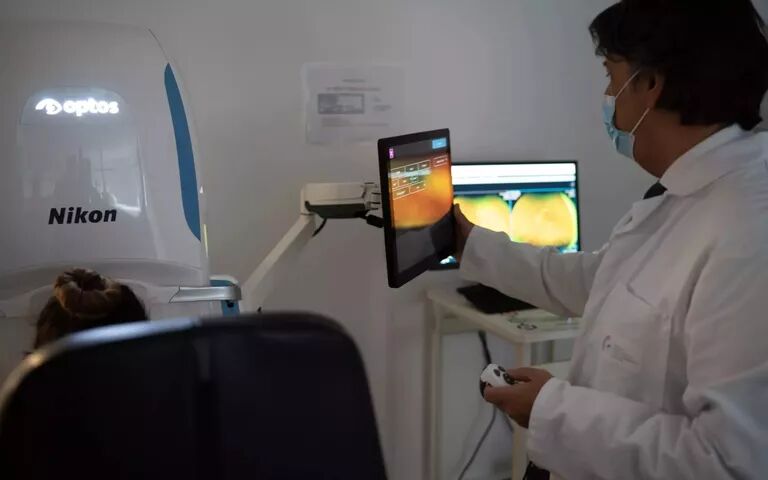
- Widefield Imaging: Widefield imaging is a technique that captures images of a large portion of the retina in a single shot. Unlike conventional imaging methods that focus on a small area of the retina, widefield imaging provides a broader view. This is particularly useful for assessing the extent of AMD, especially in its atrophic or extensive forms, allowing more efficient monitoring of disease progression.
- OCT Imaging: Optical Coherence Tomography (OCT) is an imaging technology that uses beams of light to create cross-sectional images of the retina. OCT has become an essential tool for the diagnosis and management of AMD. It allows detailed observation of different retinal layers, including the macular area. With OCT, doctors can assess retinal thickness, identify early signs of fluid or bleeding, and monitor treatment responses. Advanced OCT techniques, such as OCT-Angiography, visualize retinal vascularization, particularly useful in exudative AMD.
These advances in AMD imaging are very promising for improving early detection, monitoring, and treatment of this debilitating disease. They provide hope to individuals with AMD and their families by offering better prospects for disease management. The Creteil Ophthalmology Department has published more than 300 international articles in peer-reviewed journals in this research field.
Gene therapy
Gene therapy
Gene Therapy in Ophthalmology: A Hope for the Treatment of Hereditary Eye Diseases
Gene therapy is a revolutionary approach in medicine that aims to treat genetic diseases by introducing healthy genes into the body to correct the mutations responsible for these conditions. In ophthalmology, this approach has opened exciting new prospects for the treatment of hereditary eye diseases, such as retinitis pigmentosa. Dr. Eric Souied, after identifying the first mutations in retinitis pigmentosa in France in 1994, conducted original work in the field of gene therapy at UCCLA in 2001.
Retinitis pigmentosa is a group of hereditary retinal diseases that progressively lead to vision loss. Through gene therapy, researchers have developed treatments that specifically target the genetic mutations responsible for this disease. A notable example is the drug Luxturna®, which was approved in 2017 in the United States to treat a specific form of retinitis pigmentosa. This treatment involves injecting a viral vector containing a healthy copy of the defective gene directly into the patient's retina.
Clinical trials in gene therapy in ophthalmology have shown promising results, with significant improvement in vision for some patients. However, there are still challenges to address, including the high costs of research and development, as well as ethical concerns related to genetic modification.
In conclusion, gene therapy in ophthalmology offers considerable hope for the treatment of hereditary eye diseases such as retinitis pigmentosa. While significant progress has been made, there is still work to be done to make these treatments more accessible and address associated ethical questions. Nevertheless, gene therapy undeniably opens exciting new possibilities to enhance the vision and quality of life for patients with hereditary eye diseases.